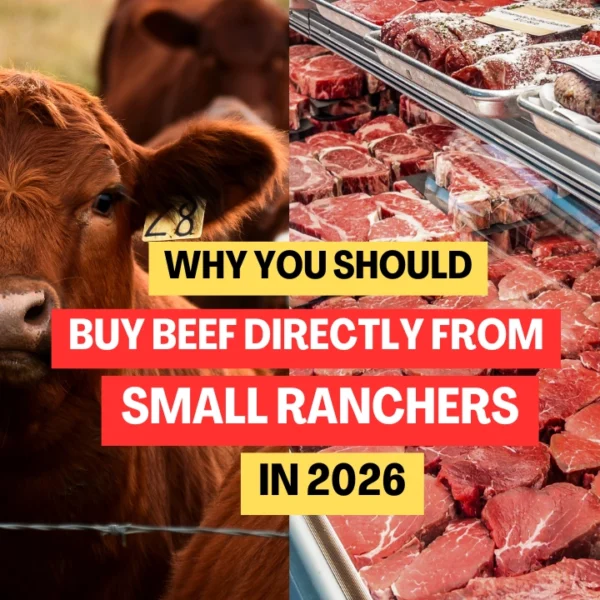
Disclaimer: The views expressed in this article are the independent opinions of ManMade Cattle and its contributors. They are based on publicly available data and industry observations. This content is provided for informational purposes only and is not intended to make factual allegations or legal claims against any person, company, or government agency. Readers are encouraged to verify all information and draw their own conclusions.
Part 1 of 2: The Problem
By Edward Perez, Owner, ManMade Cattle
Executive Summary
America’s small beef cattle producers are being systematically destroyed—not by market forces, but by regulatory agencies operating without Congressional oversight or public vote. This paper documents the compounding crisis created by four major regulatory barriers: packing company consolidation, USDA inspection requirements that discriminate against beef producers, direct-to-consumer sales restrictions, and FDA’s backdoor elimination of affordable livestock medications.
The evidence is stark: over 665,000 beef operations eliminated in one generation, cattle inventory at a 74-year low, and four companies controlling 85% of beef processing. Meanwhile, poultry farmers can process and sell up to 20,000 birds annually without USDA inspection, but beef producers cannot legally sell even one animal directly to consumers.
This is Part 1 of a two-part series. Part 2 presents comprehensive solutions, including a beef inspection exemption modeled on the proven poultry exemption and specific actions for Congress, agencies, states, producers, and consumers.
The Crisis in Numbers
The consolidation and decline of America’s beef cattle industry is quantifiable and accelerating:
- 665,000 operations lost since 1980 – More than half of all beef cattle farms eliminated in one generation
- 86.7 million head (January 2025) – Smallest cattle herd since 1951, a 74-year low
- 27.9 million beef cows – Smallest beef cow herd since 1961, a 64-year low
- 85% market concentration – Four companies control America’s beef processing
- $2,099 vs $910 per cow – Small operations (20-49 head) pay 130% MORE per cow than large operations (500+ head)
- Only 20% have vet access – Yet FDA requires veterinary involvement for basic medications
Part I: Packing Company Stranglehold
The Big Four Monopoly
Four companies—Tyson Foods, Cargill, JBS USA, and National Beef—control approximately 85% of the U.S. beef packing market. This extreme consolidation represents a dramatic shift from 1980, when the four largest beef packers controlled only 36% of steer and heifer purchases.
The concentration emerged through decades of mergers and acquisitions. JBS USA, for example, acquired Swift (the third-largest packer) in 2007, Smithfield in 2008, and Pilgrim’s Pride (the largest chicken processor) in 2009. The result is an oligopoly that can influence both the prices paid to ranchers for cattle and the prices charged to consumers for beef.
Market Power and Price Manipulation
Evidence of market power abuse is mounting:
- The farm-to-wholesale beef price spread has increased sharply in recent years, with the ‘meat margin’ widening significantly
- Tyson Foods’ net profit margin quadrupled from around 2.5% in 2015 to 10.8% in October 2021
- Ranchers’ share of beef sales totaled just 37% in 2020, down from 60% three decades ago
- Congressional testimony in April 2022 revealed profit margin increases of 400% in the packing industry since 2015
Research identified oligopolistic pricing strategies among beef packers from 2015 to 2019, suggesting cartel-like collusion when selling processed beef to retailers. Class-action lawsuits have been filed by feedlot operators alleging coordinated price-fixing practices, including intentionally reducing slaughter volumes to manipulate spot market prices.
National Security Implications
The COVID-19 pandemic exposed the vulnerability of concentrated processing. When large plants shut down in 2020:
- Grocery shelves emptied while farmers had healthy animals they couldn’t process
- Cattle prices tanked as processing capacity evaporated
- Farmers were forced to euthanize animals with nowhere to go for slaughter
- Concurrent inventory shortages drove up consumer meat prices
Two of the Big Four aren’t even U.S.-owned: JBS is Brazilian-controlled, and National Beef is 80% owned by Brazilian company Marfrig Global Foods. This foreign ownership raises serious questions about food security as a matter of national security.
Part II: USDA Inspection Requirements—The Processing Bottleneck.
The Cost Breakdown
Current USDA inspection requirements make small-scale beef production economically impossible. To process ONE beef animal through a USDA-inspected facility:
- Transportation: $100-300 (many small producers must travel 100+ miles)
- Processing fee: $400-600 per animal
- Cut and wrap: $150-250
- USDA inspection allocation: $75-150 per animal
- Total cost per animal: $725-1,300 BEFORE selling a single pound
A small producer with 10-20 animals per year cannot absorb these costs. Even selling at premium retail prices ($8-12/lb), producers must sell 150-200 pounds just to cover processing costs. With hanging weight around 400-500 pounds and actual take-home around 300-350 pounds, margins are razor-thin or negative.
Additional Barriers
Beyond direct costs, small producers face:
- Scheduling delays – Must book months ahead, limiting herd management flexibility
- Minimum order requirements – Many facilities require 5-10 head minimum
- Distance to facilities – Rural producers may be 100+ miles from nearest USDA-inspected facility
- Capital requirements – Upfront costs before any revenue
Part III: The Direct-to-Consumer Block—The Unconscionable Double Standard.
Poultry Farmers vs. Beef Farmers
The federal Poultry Products Inspection Act contains exemptions for small processors, allowing processing without continuous bird-by-bird inspection. Under the ‘20,000 bird exemption,’ poultry producers can:
- Slaughter and process up to 20,000 birds per year (~80,000+ pounds of meat)
- Process on-farm with minimal infrastructure
- Sell directly to consumers, restaurants, schools, hospitals, and retail stores
- Operate with periodic oversight rather than daily inspection
Meanwhile, beef farmers:
- Cannot sell even ONE animal without USDA inspection
- Must use distant USDA-inspected facilities (often 100+ miles away)
- Face prohibitive costs: $725-1,300 per animal
- Are completely blocked from the direct-to-consumer market
No Scientific Justification
There is NO scientific justification for this difference. E. coli O157:H7 in beef can be controlled with proper sanitation—just like Salmonella in poultry. Small-scale producers with owner-operators present provide BETTER traceability and oversight than massive facilities processing thousands of animals daily.
The poultry exemption has been in operation safely for decades under the Poultry Products Inspection Act, passed by Congress. Exempt producers still must follow sanitation, recordkeeping, and safety rules. The safety record is excellent. Yet beef producers remain completely shut out by USDA administrative interpretation that was never voted on by Congress.
Part IV: FDA’s Antibiotic Access Takeover—A Case Study in Regulatory Overreach.
The Timeline
- June 11, 2021: FDA issues Guidance for Industry #263 (GFI #263) as ‘voluntary recommendations’ for pharmaceutical manufacturers to transition remaining OTC antibiotics to prescription status
- 2021-2023: Two-year ‘implementation period’ where 100% of manufacturers ‘voluntarily’ comply with the ‘suggestions’
- June 11, 2023: Full implementation—all medically important antibiotics including injectable penicillin, tetracyclines, and other basics now require veterinary prescription
- June 2023-Present: Small farmers crushed by 1,000-2,000% cost increases for basic animal healthcare
How They Did it
The FDA did NOT pass this through Congress where the American people could vote on it. Instead, they used a backdoor approach: they issued Guidance for Industry #263, which contained ‘recommendations’ (not requirements) that pharmaceutical manufacturers ‘voluntarily’ change antibiotic labeling and restrict sales.
Every single manufacturer complied with the ‘voluntary suggestions.’ The result? A de facto law created by unelected bureaucrats without Congressional debate, public hearings, or a vote. By calling it ‘guidance’ instead of regulation, the FDA avoided the Administrative Procedure Act’s requirements for public comment and economic impact analysis.
The Real Cost to Small Farmers
BEFORE GFI #263 (Pre-June 2023):
- Pink eye treatment: $8-15 for Terramycin ointment at the feed store
- Cut or wound treatment: $10-20 for topical antibiotic
- Respiratory infection: $25-40 for injectable tetracycline or penicillin
- Time investment: Drive to feed store (30 minutes), treat animal (15 minutes)
- Total cost for minor illness: $15-40 plus one hour
AFTER GFI #263 (June 2023-Present):
- Veterinary call-out fee: $150-200 (often more in rural areas)
- Medication cost: Still $8-15 (the medicine didn’t change)
- Time scheduling: Can take days or weeks in rural areas
- Time loading cattle: 1-2 hours to load, transport, unload
- Fuel costs: $40-80 depending on distance
- Lost productivity: Entire day spent on what used to take one hour
- Total cost for minor illness: $200-300 plus full day
For a small producer with 20-50 head, these costs are catastrophic. If you treat 10 animals per year for minor ailments, your costs went from $150 to $3,000. That’s $2,850 in additional costs imposed by regulatory fiat—not by market forces, not by consumer demand, but by bureaucratic ‘voluntary guidance.’
The Deadly Consequences
Animals die because of these regulations. The reality on the ground since June 2023:
- A cow develops pink eye on Friday evening. Before June 2023, the farmer would treat it immediately. Now, the vet can’t come until Tuesday. By then, infection has spread, potentially causing permanent blindness.
- A calf gets a cut that needs simple antibiotic treatment. The farmer can’t afford a $200 call-out for a $10 problem. He tries to treat without antibiotics. It gets infected. The calf dies or requires amputation.
- A producer in a rural area has limited vet access. The nearest vet is 90 miles away and only comes monthly. Before June 2023, the farmer had antibiotics on hand. Now cattle that need treatment can’t wait.
- Small producers simply give up. The cost-benefit doesn’t work anymore. They sell out. Another farm lost.
The CattleFax survey revealed that only 20% of U.S. beef producers have a stable relationship with a veterinarian. In sheep operations, vets visited only 24% of farms annually. The FDA issued GFI #263 requiring veterinary involvement while knowing that rural America lacks sufficient veterinary services.
Who Benefits?
GFI #263 didn’t help animals, public health, or food safety. But it did help:
- Veterinary Industry: Mandatory vet visits create guaranteed revenue
- Large Producers: Industrial operations with full-time vets faced minimal cost increase. Small producers got crushed.
- Pharmaceutical Companies: By restricting sales, they eliminated discount feed store competition and forced purchases through veterinary channels at higher markups
- Regulatory Empire: More regulations mean more enforcement jobs and bureaucracy justifying its existence
Notice who’s NOT on that list? Farmers. Rural communities. Consumers. Food security. The American people never voted for GFI #263 because they were never given the chance.
The Cumulative Crushing Effect
Each regulation alone is burdensome. Together, they create an impossible business model for small producers:
- Processing costs: $725-1,300 per animal
- GFI #263 veterinary costs: Additional $2,500-3,000 per year
- Market access: Completely blocked from direct-to-consumer sales
- Packer leverage: Four companies dictate prices with 85% market control
A small producer with 10 cattle annually attempting to enter premium markets faces:
- $10,000+ in processing costs ($1,000 × 10 animals)
- $2,500-3,000 in mandatory veterinary costs
- No ability to sell directly to eager local customers
- Forced to sell to packers at suppressed prices
Even at premium prices of $3,000-3,500 per processed animal, after costs the producer nets maybe $1,500-2,000 per animal IF everything goes perfectly. One sick animal, one unexpected vet visit, one scheduling delay—and the margin evaporates.
Compare this to a poultry producer processing 1,000 chickens annually on-farm with minimal overhead, selling directly at farmers markets for $20-25 per bird. Total revenue: $20,000-25,000. Processing costs per bird: $3-5. Net profit: significant and sustainable.
What America Loses
Rural Economic Devastation
Every small farm forced out represents lost economic opportunity that ripples through rural communities:
- Direct farm income: Small producers spend money locally—feed, equipment, veterinary, supplies. Each farm supports 3-7 local businesses.
- Processing jobs: Iowa State found small slaughterhouses create 7 jobs per 1,000 cattle. Nationally, this could mean 50,000+ jobs lost to regulation.
- Multiplier effect: Every dollar of local food sales generates $1.60-$2.00 in total economic activity.
- Property tax base: When farms fail, property values drop, tax revenue falls, schools close, services disappear.
- Next generation: Young farmers can’t enter the market when startup costs include $1,000+ per animal processing PLUS $2,500-3,000/year mandatory vet costs.
National Security and Food Resilience
Four companies controlling 85% of beef processing is a national security disaster waiting to happen—and COVID-19 proved it. Concentrated processing creates single points of failure vulnerable to disease, cyber-attack, natural disaster, or labor disputes.
Every small producer forced out represents lost resilience. A distributed system of thousands of small processors is inherently more secure than dependence on a handful of massive facilities. But current regulations—from inspection requirements to GFI #263—force consolidation, creating the very vulnerability we should be preventing.
Consumer Impact
Americans want local food. They want to know their farmer. They want transparency, quality, and values-aligned purchasing. Local food sales topped $11.7 billion in 2014 and continue growing. But beef producers cannot participate.
- No access to locally-raised beef with known provenance
- No transparency about animal welfare, feed, or processing
- No support for regenerative agriculture
- Higher prices due to lack of competition (4-company oligopoly)
- Lower quality as efficiency replaces care in industrial processing
The regulatory system claims to protect consumers—but it actually denies them choice, transparency, and access to the food they want.
Conclusion: The Time for Action
The evidence is overwhelming:
- Four companies control 85% of beef processing
- 665,000 beef operations lost in one generation
- Cattle inventory at 74-year low
- Small producers pay 130% more per cow than large operations
- Processing costs make small-scale beef production economically impossible
- Beef producers blocked from direct-to-consumer sales while poultry farmers thrive
- FDA’s GFI #263 added $2,500-3,000 annual costs through backdoor ‘guidance’
This is not accidental. This is not market forces. This is systematic destruction of small producers through regulatory capture and agency overreach.
Part 2 of this series presents comprehensive solutions, including a beef inspection exemption modeled on the proven poultry exemption, specific actions for Congress to reassert authority over agencies like the FDA, and a call to action for all stakeholders. The solutions exist. The time to implement them is NOW.
Sources & References
Cattle Inventory Data:
- USDA NASS, Cattle Report, January 2025 (86.7 million head, 27.9 million beef cows)
- USDA ERS, Cattle & Beef Sector at a Glance, 2025
- USDA NASS, 2022 Census of Agriculture
Packing Industry Concentration:
- USDA ERS, ‘Concentration in U.S. Meatpacking Industry,’ Amber Waves, January 2024
- Ward, C., ‘Assessing Competition in the U.S. Beef Packing Industry,’ Choices Magazine, 2010
- U.S. House Agriculture Committee testimony, April 27, 2022
FDA GFI #263:
- FDA, Guidance for Industry #263, June 11, 2021
- Oklahoma State University Extension, ‘Some OTC Antibiotics to Move Under Veterinary Oversight,’ May 2023
- University of New Hampshire Extension, ‘FDA Guidance for Industry No. 263,’ 2023
Poultry Exemptions:
- USDA FSIS, ‘Guidance for Determining Whether a Poultry Slaughter or Processing Operation is Exempt,’ 2006
- Penn State Extension, ‘Marketing Poultry Slaughtered Under USDA Exemption’
- Niche Meat Processor Assistance Network, ‘Understanding Poultry Exemptions’
About the Author
Edward Perez is the owner of ManMade Cattle, a beef cattle operation committed to quality production and fighting for the survival of American family farms. As a small-scale producer, Edward has experienced firsthand the crushing weight of regulatory overreach and the systematic destruction of opportunities for independent ranchers.
Contact Information:
Edward Perez
ManMade Cattle
Phone: (302) 272-3625
Note: This white paper is provided for educational and advocacy purposes. It represents documented research and the lived experience of American beef producers facing regulatory overreach. This is Part 1 of a two-part series. Part 2 presents comprehensive solutions and specific calls to action.
Read Part II Below
Grass-Fed vs Grain-Fed Beef: What Consumers Are Not Being Told
Walk into any grocery store, and you will find the same confusing labels staring back at you. Grass-fed. Grain-fed. Grass-finished.…